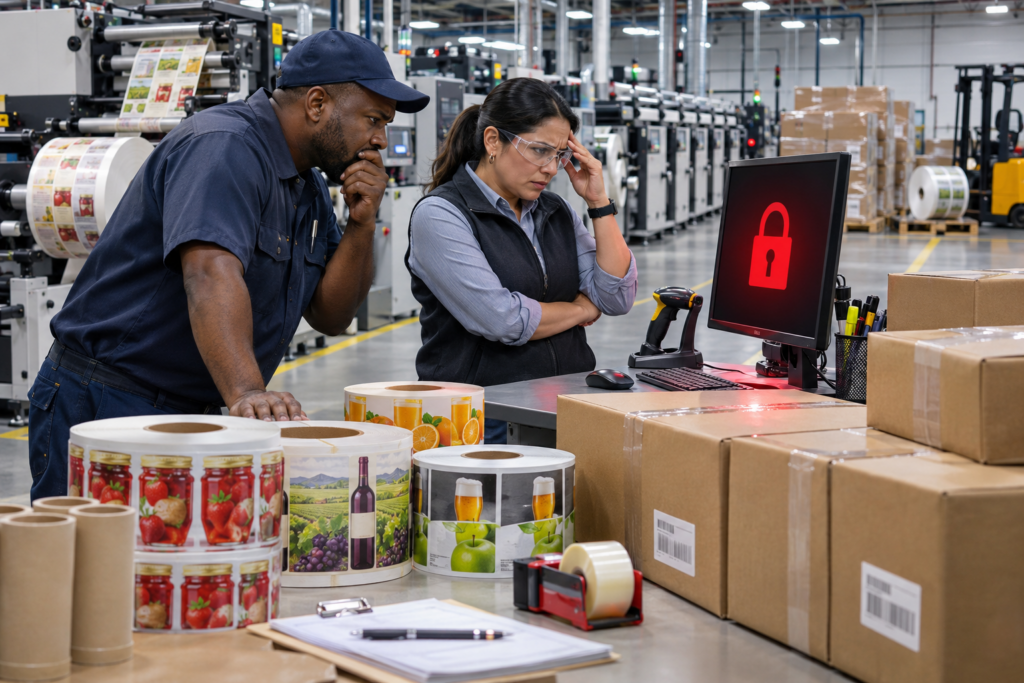
Ransomware can stop your label plant without touching a press. Learn what’s at risk and how to assess your readiness before an attack.
A label is the last thing a food plant thinks about, until it isn’t there. No label, no shipment.
That is why a report out this week deserves a label converter’s attention. Dragos, an industrial cybersecurity firm, counted 876 ransomware incidents at manufacturers between July and September, up from 747 the quarter before. Manufacturing now takes 69% of all industrial ransomware, up from 62% at the start of the year.
Look at who is inside those numbers. Food and beverage makers logged 90 incidents, up from 57 in the first quarter. Pharmaceutical makers went from 19 to 46. Those are your customers.
How ransomware can stop a label plant
In July, a ransomware attack stopped production at four U.S. plants of Coca-Cola’s Fairlife for about 11 days. Dragos makes the point that matters most to a converter: attackers can stop a plant without touching a single machine. They lock the business systems that tell the machines what to run.
In a label plant, that is your MIS: estimates, job tickets, the schedule, stock, die and plate records, shipping. Your presses will still turn. Nobody will know what to put on them.
Common cybersecurity assumptions among label converters
After more than 40 years building software for this industry, we hear the same two things. First: “We’re too small to be a target.” Last quarter, 99 different groups claimed industrial victims, up from 70. They are not picky. Second: “Our IT guy backs it up.” Often that means one server in a back office, one part-time person, and a backup nobody has test-restored.
How ransomware puts customer relationships at risk
There are two costs. The first is days down. Your customers run lean on labels, and every day you can’t ship is a day they spend qualifying a second source.
The second is scrutiny. Brands that have been hit get strict about suppliers. Expect security questions in your next audit or RFQ: where is your data, who patches the system, how fast can you restore? A written answer wins work. “I’ll ask our IT guy” does not.
This is the practical case for cloud: a system that is monitored, patched and backed up every day, not when someone has time. It also matters who does that work. A general hosting company can restore a server. It can’t tell you whether your job tickets and stock came back right. The team that built your MIS can.
That is how we built Label Traxx Cloud, starting with estimating in the browser, and Amtech Cloud Hosting: security monitoring, patching, and backup and recovery from the people who know Label Traxx.
Two steps to assess your label plant’s cybersecurity
- Run the 6 a.m. test. Ask whoever looks after your server: if the MIS were locked at 6 a.m., how would we print job tickets and ship today’s orders? When was the last test restore? Write down the answers.
- Write your one-page answer for customers. Where your data lives, who patches it, how long a restore takes. You will be asked.
Then take Amtech’s two-minute, seven-question cybersecurity assessment to see your risk and what it could cost, or talk to a Label Traxx Cloud expert about moving to the cloud.