Capture the know-how that keeps your label plant running, give new operators a stronger start, and build a practical foundation for AI.
Grant Emison | November 11, 2026
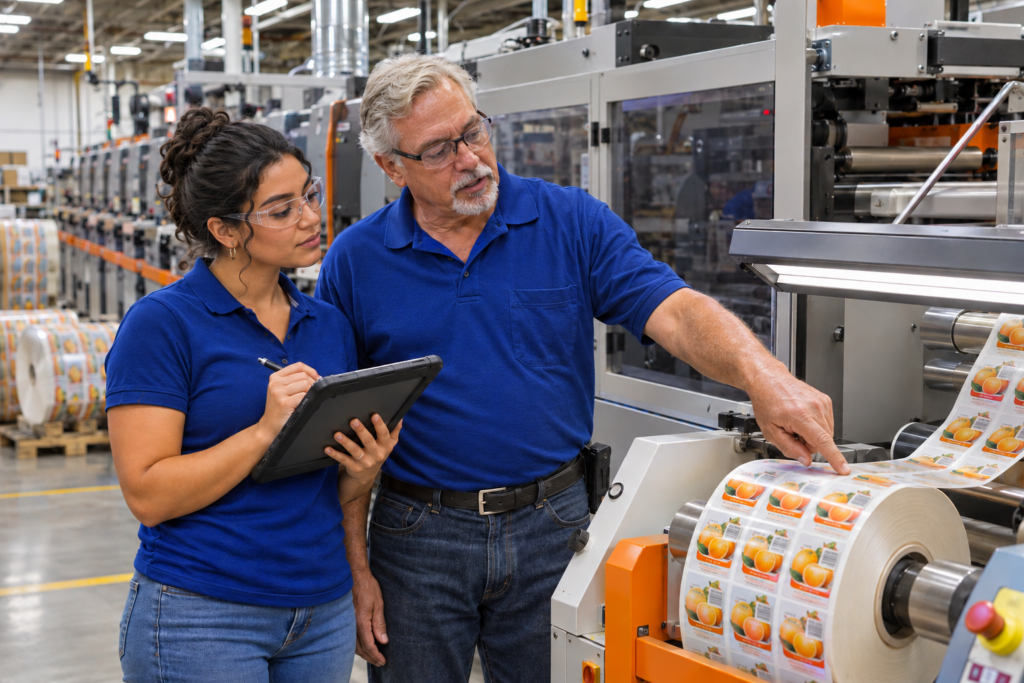
Edward has been running presses at a label converter we’ll call Lakeshore Label for 26 years. He knows the white BOPP for the salsa customer runs cleaner on Press 4, that one particular die always needs extra make-ready, and that the pharma customer reorders about two weeks ahead of forecast.
You won’t find any of that on a job ticket. It lives in Edward’s head, and Edward plans to retire in 2029.
Every label plant has an Edward
If that sounds familiar, you would have had plenty of company at the TLMI Annual Meeting in Fort Lauderdale late last month, where the retirement wave came up again and again.
Consultant Brian Van de Water warned converters that their experienced printers and most highly skilled employees will be leaving within the next five years, and urged them to capture how those people do the work while they are still on the floor. Workforce advisor Claudia St. John followed with the harder news: the group coming into the workforce is a lot smaller than the group heading out, so most plants shouldn’t count on hiring another Edward.
What the AI numbers are really telling us
AI had its own session at the same meeting. Chelsey Quick of Industry Intelligence reported that 85% of respondents see AI as critical to staying competitive, yet only 7% have a defined roadmap for it, and just 11% said cost was a barrier.
In other words, most converters believe they need AI and could find the money for it. What they are missing is a sensible place to start.
Start with what Edward knows
We think those two conversations were really about the same thing. Any software, AI included, can only work with what it has been given. When the way a plant actually runs is spread across one person’s memory, a spreadsheet and a whiteboard, there isn’t much for the software, or a new hire, to learn from.
That is why the first step toward AI usually isn’t buying AI. It is getting what Edward knows recorded as jobs run: which press a job belongs on, how long setup really takes and how much waste to expect. As Van de Water put it, “It’s not automation or people – it’s both.”
What that looks like in a label plant
Amtech has been building software for this industry for more than 40 years, and this is the job Label Traxx was designed to do. The quote, the job ticket, the press time and the invoice all sit in one system, and setup time and waste are recorded while the job is running. Amtech Intelligence then works from your own job history.
We won’t tell you this happens overnight. Software changes are rarely fun, and it goes best when a plant takes it one press, or one customer, at a time.
For an owner, the payoff is a plant that keeps running the way Edward runs it after he’s gone, and a new operator who has something to follow on day one.
Two things you can do this week
- Sit down with your Edward. Choose three of your toughest repeat jobs and ask him what he knows about each one that isn’t on the ticket. Write it down.
- Compare quoted with actual. Pull last month’s 20 biggest jobs and look at the setup time and waste you quoted next to what really happened. If that takes longer than ten minutes to find, you’ve found your starting point.
If you’d like to see how this would work on your own jobs, bring a few to Amtech Software and we’ll walk through them with you in Label Traxx.
Edward and Lakeshore Label are a composite, not a specific customer.