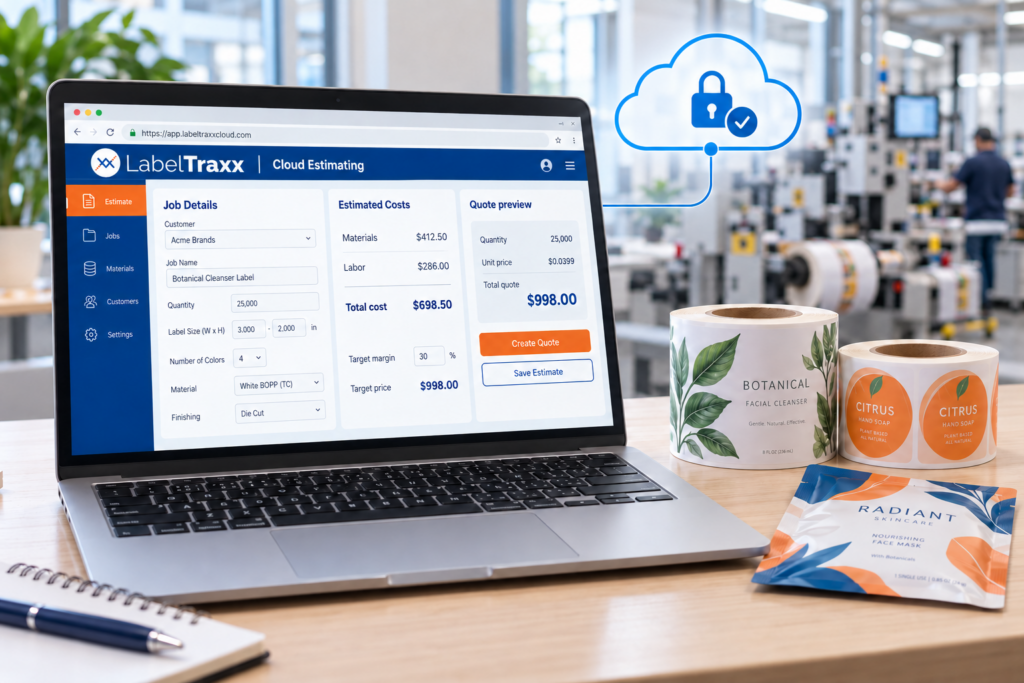
Better quotes start with clearer costs. Label Traxx Cloud brings familiar estimating workflows to your browser, with less IT upkeep.
By Grant Emison
Every label job begins with a question, and you know it by heart: What will this cost, and what should we quote?
Everything after it, from the press schedule to the materials to the margin you actually keep, is shaped in the next few minutes by an estimator, a spreadsheet, and a good deal of institutional memory. Get it right and you win work you can make money on. Get it wrong and you either lose the job or win one you wish you hadn’t.
That is exactly why, when my team set out to bring Label Traxx to the cloud, we decided to start there. I’m excited to tell you that Label Traxx Cloud is now available, and its first release is Estimating.
The quote is where margin is won or lost
Let me paint a scene you may recognize. A customer sends in a request for a custom, short-run job. Your estimator knows the press, the substrate, even the quirks of the die. What they don’t always have is a fast, reliable way to cost every piece of it, see the margin that results, and get a clean quote out the door before a competitor does.
So they improvise. A side spreadsheet here. A rebuilt set of numbers in a separate quote document there. It works, right up until you find out what the margin really was after the quote went out, which is the one moment you can’t do anything about it.
Quote slowly and you lose jobs. Quote blindly and you win the wrong ones. I’d bet you’ve felt both.
Built for labels, not adapted to them
A generic manufacturing ERP was designed for a different world: fixed products, repeat orders, tidy bills of materials. Label, flexible packaging and shrink-sleeve work is high-mix, custom and full of vocabulary a generic system has to be taught, or worse, forced to fit. The result is a compromise you have probably learned to live with. You can have a system that fits, or you can have speed. Pick one.
We don’t think you should have to. Label Traxx has been built around converters for years and runs at more than 600 installations with over 60,000 users across North America, South America and Europe. Label Traxx Cloud Estimating takes that foundation and puts it on the web, so the end of compromising between fit and speed isn’t a slogan. It’s the job description.
What Cloud Estimating actually does
It follows the way your best estimator already thinks, just without the duct tape:
- Model the cost, speed and capacity of your presses, equipment and materials for custom label and flexible packaging work.
- Cost the labor and the materials for each job.
- Tune your expected margin and build in commission costs before the customer ever sees a number.
- Turn the estimate into a customer-ready quote letter, with the customers and prospects behind it kept in one place.
Estimate. Know your margin. Quote. In that order, in one system.
I’m not going to hand you a number for how many minutes this saves. Every shop’s jobs are different, and I’d rather prove it on one of yours than promise it on a slide.
Now, about that server in your building
Mention an ERP upgrade to your IT manager and watch their face. It isn’t a question so much as a look, and it says: I lose a weekend to this, and if it goes badly, I own that too.
The upgrade is the least of it. When your ERP lives on a machine in your building, you own things you never asked to own:
- Whether the backups ran, and whether they would actually restore, which is a harder question to answer with a straight face.
- The patching, the maintenance and the upgrade weekends that come with it.
- Keeping criminals out of the system that holds your orders, your costs and your customers.
And think about what lives in that system. Your estimating data is your cost structure, your margins and your customer pricing. It is some of the most valuable information in the building, and it sits on hardware that someone has to babysit.
I’m not suggesting you’re doing any of this badly. Most converters I talk with are doing it about as well as anyone could while also making labels for a living. That’s the real problem. Backup and disaster recovery is a specialty. Cyber defense is a specialty. Neither one is your specialty, and neither should have to be.
With Label Traxx Cloud, there is no ERP server to maintain and no upgrade weekend to lose. Amtech takes on more of the hosting, maintenance, upgrades, backup, failover and cyber defense. That means enterprise-grade security, backup and failover without an enterprise IT budget. Less infrastructure. More time for the business.
Same Label Traxx, a stronger foundation
I have sat in enough rooms to know what “we’re moving to the cloud” usually means in ERP: a new system, a re-implementation, and a long stretch of your life you won’t get back.
That is not this. Label Traxx Cloud is Label Traxx with the infrastructure taken off your plate. It keeps the familiar Label Traxx terminology, warnings, validations and workflows, so established teams face a much shorter learning curve.
Estimating is the first phase, and it is available now. More of Label Traxx Cloud is planned in phases over the coming months, leading up to 2028, so you’re adopting a foundation designed to keep expanding. There’s no forced timeline, and nobody is moved on our schedule. When you’re ready, we’ll work through the move with you.
And if you don’t run Label Traxx today, this is worth a look too. It’s a modern alternative to a generic ERP, designed around label and flexible packaging realities from the beginning.
Come and be difficult with us
The best way to judge an estimating tool is to hand it a hard job. Bring one you think will break it: the odd substrate, the short run, the quote that always takes your estimator an afternoon. Let’s see what happens to the cost, the margin and the quote letter.
If you’d like to see Label Traxx Cloud Estimating in action, or you just want to talk it through with the product experts who build it, visit the Label Traxx Cloud page and fill out the form to request a demo or speak with a product expert. I would much rather have the awkward questions now than after you’ve made a decision. I’d love to hear which job you bring.

Grant Emison
Director of Product Management