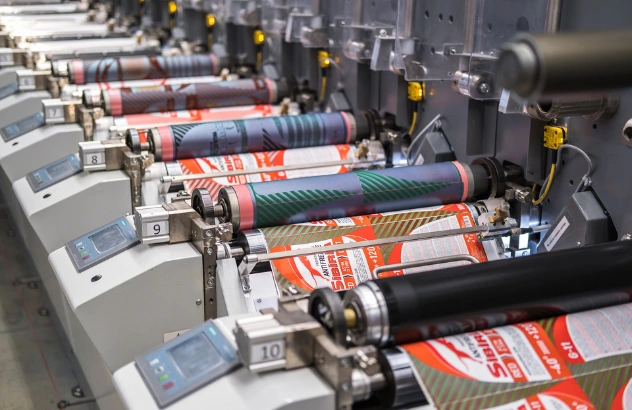
In label converting, complexity doesn’t announce itself. It shows up quietly in the daily shuffle: short runs mixed with repeat jobs, urgent SKU launches, version changes for promotions, material swaps, and compliance-driven artwork revisions. What looks manageable on paper becomes volatile on the production floor.
Many label operations assume their primary constraint is press capacity. More orders mean more press time — simple math. But for converters running flexo, digital, and finishing across multiple lines, the real bottleneck is rarely ink on substrate. It’s coordination. And that’s where scheduling either creates margin — or erodes it.
Scheduling determines whether complexity becomes cost
Label manufacturing is especially vulnerable to scheduling drag because so much of the work is interconnected. Substrates, dies, inks, coatings, laminations, finishing steps — each decision affects setup time, waste, and downstream flow. When scheduling lives in spreadsheets or manual sequencing, small disruptions cascade. Changeovers multiply. Backlogs grow. Lead times stretch.
The issue isn’t effort. Most converters work incredibly hard to keep presses running. The issue is visibility. Without a unified, real-time view of capacity, work-in-progress, and material availability across departments and often across facilities — planning becomes reactive. Expedites override logic. Firefighting replaces optimization.
When scheduling is treated as a system-level discipline rather than a clerical task, the dynamic changes. Batched sequencing reduces changeover waste. Automated prioritization prevents urgent jobs from destabilizing the entire floor. A single, synchronized view across estimating, production, and finishing aligns decisions before problems surface.
The result isn’t just faster throughput. It’s predictability that something increasingly rare in an industry defined by shorter runs and faster turnaround expectations.
The takeaway
In label converting, operational performance doesn’t hinge solely on press speed or equipment investment. It hinges on how intelligent work is sequenced and synchronized.
Converters that rely on manual scheduling often compensate with overtime, excess WIP, and margin leakage. Those that elevate scheduling to a connected, data-driven function gain something more valuable than incremental efficiency: control. And in a market where brand owners expect rapid changes without disruption, control becomes a competitive advantage.
Understanding this distinction is critical. Because if coordination is the true constraint, adding more capacity won’t solve the problem, it will simply scale the inefficiency.
For readers who want to explore this topic in more depth
The full case study on Taylor Prime takes a closer look at how this multi-facility label converter transformed their production efficiency through the Label Traxx Batched scheduling solution. This case study shows what automating meant for lead times, backlog, and operational visibility.