The Order That Used to Take a Day Now Takes an Hour. And There Are Eight More Behind It.
Ask any production manager at a labels or flexible packaging plant what’s changed most in the past five years, and the answer is almost always the same: the jobs got smaller, the SKU counts exploded, and somehow the delivery windows got tighter.
Brands are now reporting 20 to 40% more SKU variants year over year, seasonal editions, regional flavors, retailer-specific packs, limited runs. Average order sizes are running 15 to 30% lower than pre-2020 norms.
That math hits a labels plant hard. More changeovers. More makereadies. More time not printing. And more scheduling complexity than any whiteboard or spreadsheet can realistically manage.
The plants absorbing this shift efficiently have something in common: they’ve stopped trying to manage high-mix, short-run production the way they managed long-run production. They’ve moved to AI-driven scheduling and production management and the gap between those plants and the ones still running on legacy systems is widening every quarter.
Changeovers Are Where Margin Goes to Die
Here’s the operational reality for a labels plant running a high-SKU mix: a flexographic changeover can consume 20 to 60 minutes, plates, anilox rolls, registration, color matching. Multiply that across a full production day and you’re losing hours of press time to setup. On short runs, that math often means the job itself costs more to set up than it does to run.
The problem isn’t the press. It’s what’s upstream of the press: the scheduling system. Most legacy scheduling tools in the labels industry were designed for long-run, stable production environments. They optimize for machine utilization in a world where jobs don’t change every two hours. In a high-mix environment, they’re producing schedules that feel logical on paper and create chaos on the floor, wrong ink families batched together, die tooling conflicts, jobs sequenced in ways that maximize changeover time rather than minimize it.
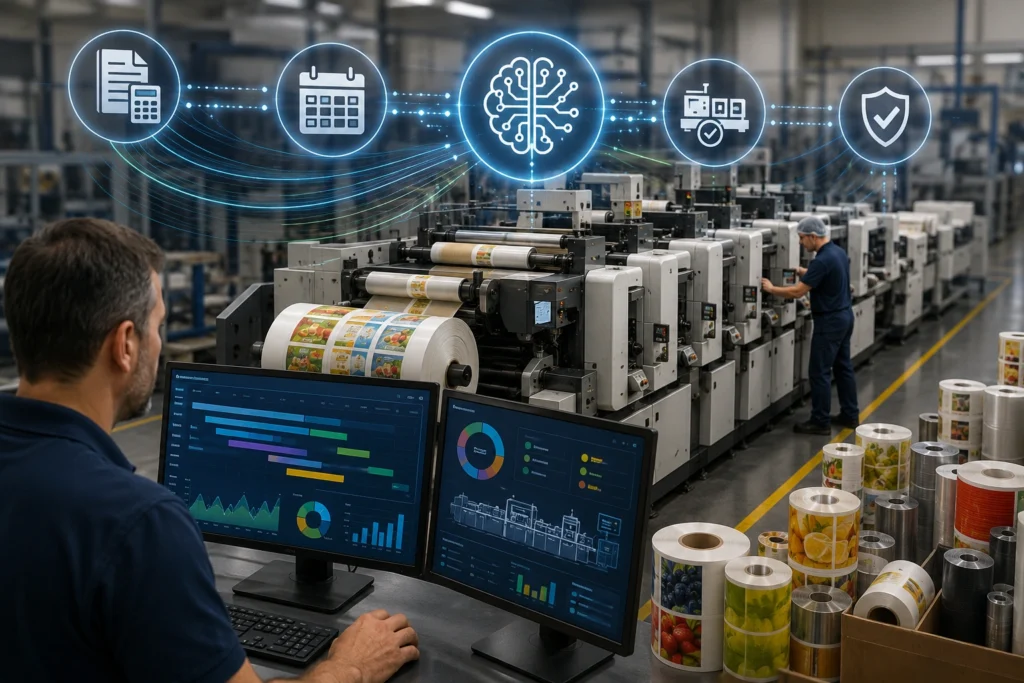
AI-driven scheduling changes this fundamentally. By analyzing order attributes, substrate, ink set, tooling, run length, and due date, AI scheduling engines sequence jobs to cluster similar setups, minimize changeover time, and surface conflicts before they hit the press. The result isn’t marginal efficiency improvement. Early adopters are reporting 10 to 20% production output gains without adding equipment or headcount.
Built for the Complexity Labels Plants Live In
Amtech’s was built with this production reality in mind. Integrated estimating, AI-assisted scheduling, and real-time quality management aren’t separate modules bolted together, they’re a single system sharing a common data model. When an order changes, scheduling updates. When production falls behind, the system flags the downstream impact. When a quality event occurs, it’s captured and traceable without manual documentation.
For a labels plant managing hundreds of active SKUs and dozens of jobs per day, that integration isn’t a nice-to-have. It’s the foundation of a profitable operation.
Actions to Take Now
Action 1: Pull your changeover data from the last 90 days. Calculate total setup time as a percentage of total press hours. If that number is above 20%, you have a scheduling and sequencing problem that AI can directly address.
Action 2: Talk to Amtech about how AI-driven scheduling applies specifically to your mix of substrates, print processes, and run lengths. The efficiency gains are real, but they require a platform connected deeply enough to act on your actual production data.
Your customers aren’t going back to fewer SKUs. The plants that win the next five years are the ones building the operational infrastructure to handle complexity at scale — without sacrificing margin to do it.