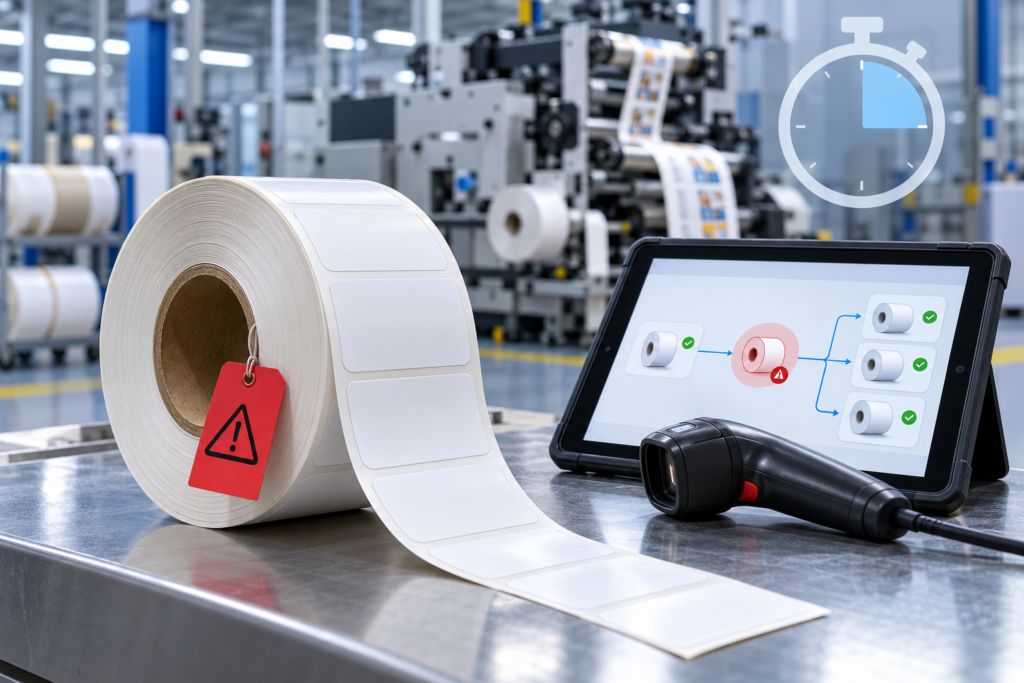
When a customer calls about a defect, slow answers cost you more than the bad roll. Here’s how to close the gap.
A customer calls. A label is lifting on the bottle line, and they want to know which other shipments contain the same material, by the end of the day.
In many label plants, answering that means pulling the job ticket, checking timestamps on the press log, asking the slitter operator what they remember and hoping the material lot was written on the right sheet. It takes hours. And because no one is sure, the plant quarantines everything printed that week.
That isn’t a quality problem. It’s a data problem, and it’s getting more expensive.
Why traceability is now a sales issue
Three changes are hitting label and flexible packaging converters at once.
Buyers want proof of lineage. Recyclability claims, wash-off adhesives and food and pharma compliance mean brand owners increasingly ask converters to show which raw-material rolls, press and slitting lane produced each finished roll. A converter who answers in minutes looks like a partner. One who answers in days starts to look like a risk.
Digital printing multiplies the number of rolls to track. As more output moves to digital presses, jobs get shorter and more frequent. More jobs mean more parent rolls, more lanes and more changeovers, each a gap where lineage can be lost if it isn’t captured as the work happens.
Your data is a target. GuidePoint Security counted a record 2,760 ransomware victims in Q3 2026, up 75% from a year earlier, and manufacturing was the most attacked industry again. If your traceability lives on a server in a closet, a single attack can wipe out both your production data and your ability to answer the customer.
Where most plants get stuck
Most converters track rolls across press logs, spreadsheets and a quality system that doesn’t talk to the ERP. Lineage only works if it’s recorded in the same system that holds the order, the estimate and the shipment.
That’s the thinking behind Track & Trace in Label Traxx. Each roll’s length, width, number across, parent material, lane, press and operator are recorded in the ERP, and finished rolls, cartons and pallets are serialized against the shipping manifest. When a defect turns up, you trace back to the source roll and forward to every order it touched, then quarantine only what needs it.
Where the data lives matters too. Label Traxx on the Cloud keeps the screens your team already knows, migrates your data automatically, and moves backup, fail-over and cyber defence from your plant to Amtech. The first converters move onto the Cloud Starter edition this November.
There’s one more benefit. Clean, serialized roll data is what AI needs to predict which materials, presses or lanes cause waste before the customer calls. Plants that capture lineage now will be ready to use AI on it later.
What to do this week
- Run a mock trace. Pick a roll that shipped last month and time how long it takes your team to name its parent material, press, lane and every other order that used the same lot. If it takes more than 15 minutes, you’ve found the gap.
- Run a recovery test. Ask IT one question: if our ERP server were encrypted tonight, how many hours of production data would we lose, and how long would it take to restore? Write down the answer.
Amtech has helped label and flexible packaging converters run their plants for more than 40 years. Let’s make your next trace a 15-minute job.
- See Track & Trace: trace any roll back to its source and forward to every order it touched.
- See Label Traxx Cloud: keep your familiar screens while Amtech handles backup, fail-over and cyber defence.

Grant Emison
Director of Product Management