Most packaging plants assume they’re protected because they have backups, firewalls, or IT support in place. But recent shifts in how cyberattacks operate are exposing a different reality: protection is no longer the same as resilience.
As attacks become faster and more automated, the real risk isn’t just whether a breach happens, it’s how quickly it spreads and how long operations stay disrupted. In manufacturing environments, that distinction matters more than anywhere else. Because when systems go down, production doesn’t slow, it stops.
The question isn’t “Are we secure?” It’s “How long could we keep producing if something fails?”
Cyber resilience is about containment and continuity
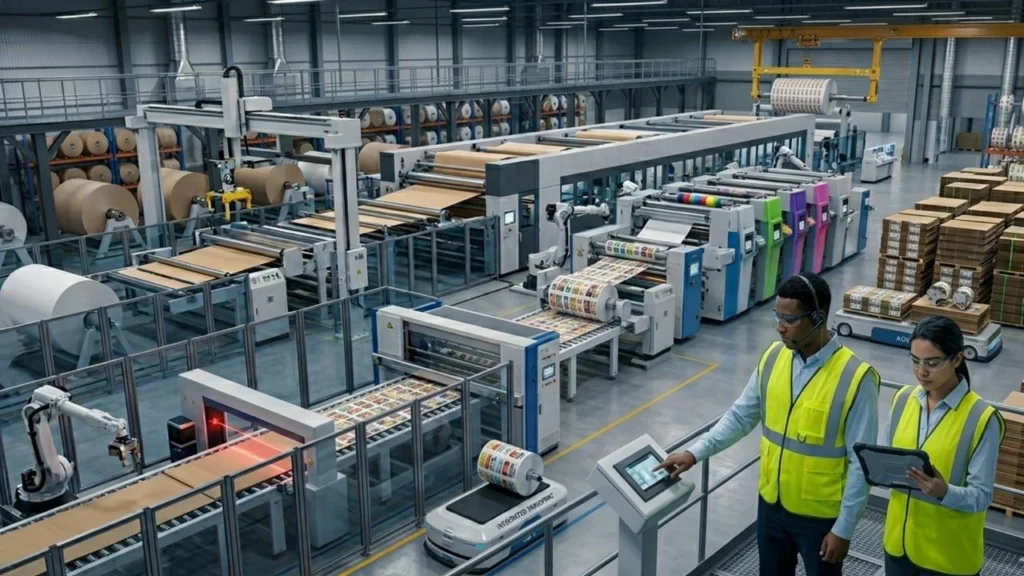
In sheet plants, box plants, folding carton plants, and label manufacturing plants, operations and systems are deeply interconnected. ERP, MES, scheduling, inventory, and machine-level systems are designed to share data seamlessly. That connectivity drives efficiency, but it also creates pathways for disruption.
Cyber resilience starts with recognizing that these connections are not just operational, they are structural dependencies. When one system is compromised, the risk isn’t isolated. It moves.
That’s why resilience is less about preventing every possible intrusion and more about limiting how far and how fast problems can travel. Containment becomes just as important as defense.
The same principle applies to recovery. Many organizations focus on whether data is backed up, but far fewer understand what it takes to actually restore operations under pressure. There’s a significant difference between having data stored somewhere and being able to restart scheduling, quoting, and production within hours.
In practice, resilience shows up in two ways:
- how quickly a breach can be identified and contained, and
- how quickly operations can be restored.
Without both, even a minor disruption can escalate into a full shutdown of production.
Takeaway
Cyber resilience in packaging isn’t an IT metric, it’s an operational capability.
It’s easy to think of cybersecurity as a technical layer sitting outside the business. But in reality, it defines how reliably a plant can meet commitments when something goes wrong. The strength of that capability isn’t measured by how many tools are in place, but by how the system behaves under stress.
The risk is assuming that protection equals preparedness. Without a clear understanding of how systems interact, how access is controlled, and how recovery actually works, most plants are more exposed than they appear.
Explore the bigger picture
For readers who want to explore this topic in more depth and learn about AI-Accelerated Cyber Attacks, you can read our whitepaper on this topic “Shielding Your Plant From AI-Accelerated Cyber Threats” and/or Take our Cybersecurity Risk Assessment.